 BLACK FOREST
The Back
Of The Tub
- 00Foreword: The Number on the Front
- 01Expose: What the Number Hides
- 02The Billthe scale they never print
- 03Equip: Why the Shelf Protein Fights You
- 04Prime: Read the Tub in 60 Seconds
- ·The Receipts & Disclosures
The Number on the Front
A protein bar promises you seventeen grams. Someone got suspicious, sent it to an independent lab, and the lab found as little as eight. Not a rounding error. More than half the number on the front, simply not there.
How does a company print seventeen and deliver eight without lying, at least not in a way the law can easily catch? The answer is not really about that one bar. It is about how the number itself is made. Every gram of protein on every label in America, on the tub, the bar, the carton of milk, comes from a single test, and the test does not measure protein.
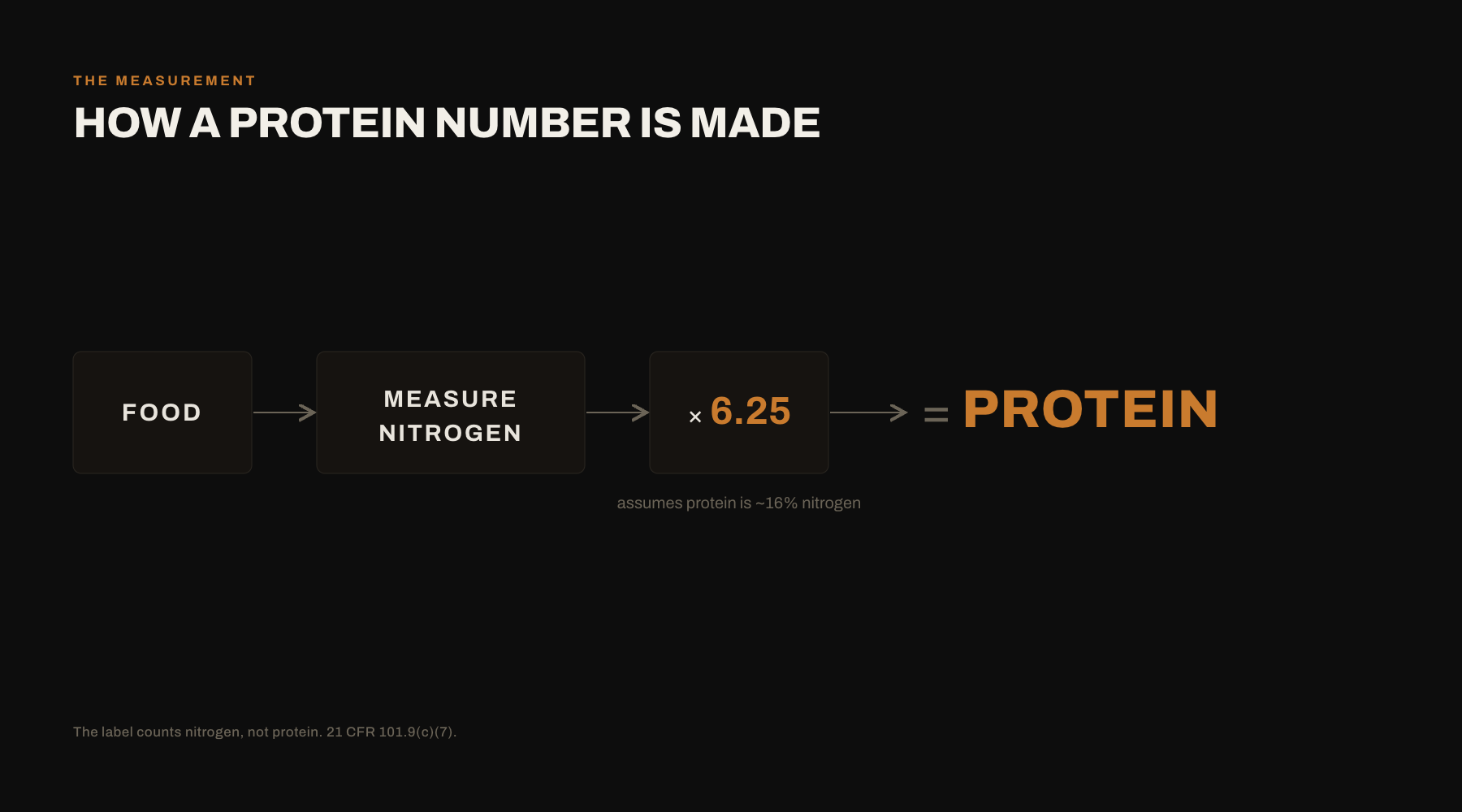
It measures nitrogen. In 1883 a Danish chemist named Johan Kjeldahl, working in the laboratory of the Carlsberg brewery in Copenhagen, needed a quick way to check the protein in barley. He worked out that if you break a food down and measure the nitrogen it gives off, you can estimate its protein, because protein runs about sixteen percent nitrogen. Measure the nitrogen, multiply by 6.25, and you have a number. It was clever, it was fast, and for barley it was good enough. More than a century later, it is still the method the law requires for the number on your tub.
Here is the flaw it was born with. The test never sees protein. It sees nitrogen and assumes the nitrogen came from protein. Give it nitrogen from something cheaper and it counts that too, then prints the total on the front as grams of protein.
That one assumption is the crack this whole guide runs through. It is how a bar prints seventeen and delivers eight. It is how, in one infamous case, a chemical that had never been near a cow ended up counted as milk protein. And it is why the only honest number is not on the front of the package at all. It is on the back, in the fine print, if you know the five things to look for.
This guide teaches you to read the back of the tub in about sixty seconds. There is nothing to buy in it. I sell protein for a living, so read every page with the suspicion it deserves. But I would rather hand you the tools to check my label than ask you to trust it, because a number you can verify is worth more than a number you have to believe. Start with four things you have almost certainly bought. Tap each one and turn it over.
To your strength,
Antonio Colmenares
Founder, Black Forest
What The Number Hides
Start with what the machine actually does, because once you see it you cannot unsee it. A lab takes your protein powder, digests it in acid until everything organic breaks apart, captures the nitrogen that comes off, and counts it. Then it multiplies that nitrogen by 6.25 and calls the answer protein. The whole edifice rests on one sentence from 1883: assume protein is sixteen percent nitrogen, and the rest is arithmetic.
The assumption is not crazy. Real, whole proteins really do land near sixteen percent nitrogen, give or take, which is why the test survived for a hundred and forty years. But notice what it means. The number on the tub is not a count of protein molecules. It is a count of nitrogen atoms, converted by a fixed multiplier that has no idea where the nitrogen came from. The test cannot tell the nitrogen in a chicken breast from the nitrogen in a bag of fertilizer. To the machine, nitrogen is nitrogen.
If you wanted to make cheap product look expensive, you would not need to add protein. You would only need to add nitrogen, from the cheapest source you could find, and let a test from the nineteenth century do the lying for you. For most of the method's life, nobody bothered, because nobody had a reason. Then the incentives arrived.
The proof, in the worst possible form
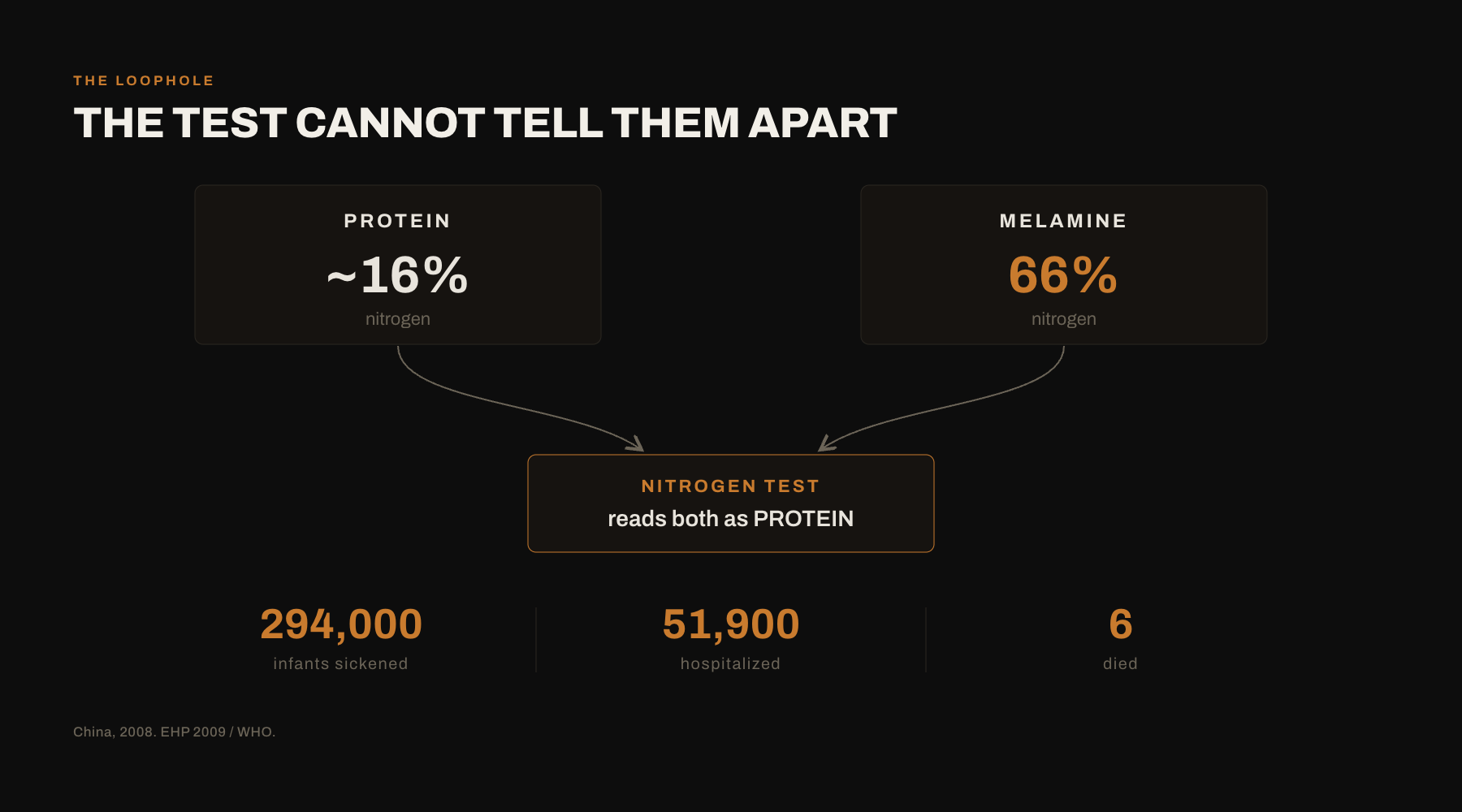
In 2008, dairies and middlemen in China were watering down raw milk to stretch it. Watered milk fails the protein test, because diluting the milk dilutes its nitrogen. So someone added a white industrial powder called melamine, which is about sixty-six percent nitrogen by weight, one of the most nitrogen-dense compounds you can buy cheaply. The milk tested fine. Every nitrogen-based protein check, the same family of test that measures your tub, read the melamine as protein and waved it through.
Roughly 294,000 infants were sickened. About 51,900 were hospitalized. Six died.
The melamine scandal was a crime, not a marketing tactic, and no protein company you can buy from is poisoning anyone. Hold onto the mechanism, though, because it is the same one, only legal and much quieter, on the shelf at home. The 2008 disaster is the cleanest proof ever produced that the number on a label is a nitrogen reading, and that a nitrogen reading can be fed. A test that cannot tell milk from a plastics chemical is not going to notice a scoop of cheap amino powder.
The nitrogen method persists because it is cheap, fast, and standardized worldwide, and because for honest whole foods it is close enough. The newer combustion method that replaced it in many labs measures nitrogen too. The industry did not keep a broken test by accident. It kept a convenient one, and the inconvenience lands on you, in the fine print, one tub at a time.
The quiet version, on the shelf
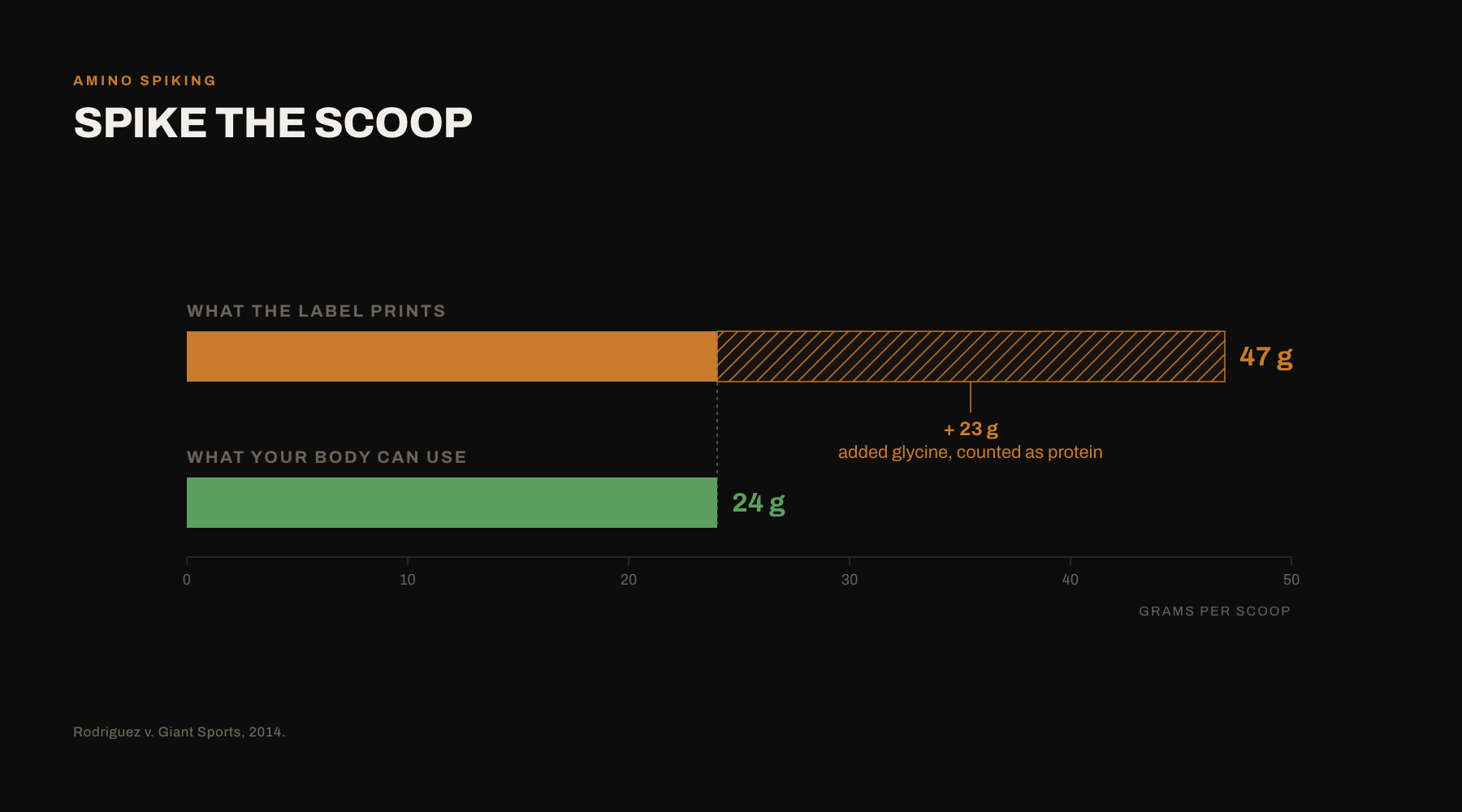
You do not need melamine to game a nitrogen test. You can do it with ingredients that are legal, sold by the drum, and technically food. Free amino acids like glycine, and other nitrogen-rich fillers like taurine and betaine, are far cheaper than real protein and loaded with nitrogen. Stir them into a powder and the test counts their nitrogen as protein, so the number on the front climbs while the actual protein your body can build from stays flat. The industry has a bland name for it: protein spiking, or nitrogen spiking.
This is not a theory. In 2014 a supplement maker was taken to court over a powder called Delicious Protein. Independent testing, according to the complaint, found it delivered about sixty percent less protein than the label claimed, and that nearly four grams of glycine per serving had been added but left off the panel, padding the nitrogen reading. The label was not measuring a lie exactly. The test was doing precisely what it was designed to do, counting nitrogen, and someone had simply given it cheaper nitrogen to count. Move the slider and watch the trick work.
Then the word itself became the product
Spiking is the outright con. There is a softer move that is now everywhere, and it is perfectly legal. Take a food that was mostly starch or sugar, add a spoon of isolated protein, and print a big number on the front. The cereal, the creamer, the snack bar, the bottled shake. Since 2021, the number of food and drink launches carrying a protein claim has climbed about six percent a year, led by cheap milk, pea, and soy isolates dropped into cereals, dairy, and snacks. Call it protein-washing. The protein is real, in the narrow sense that the nitrogen is there. What is missing is any reason to think a spoonful of isolate bolted onto a bowl of refined grain is doing for your body what the sticker implies.
So now you know the first half of the story. The number on the front is a nitrogen reading, and a nitrogen reading can be diluted, spiked, or bolted onto junk. But suppose a label is completely honest. Suppose the grams are real, whole protein, every one of them measured true. There is still a second number the front of the tub will never show you, and it is the one that decides whether the protein does anything at all.
The Scale They Never Print
Say the grams are real. Every one of them whole protein, measured true, no spike, no filler. There is still a question the front of the tub refuses to answer, and it is the only one that decides whether the protein does anything: can your body actually build with it?
Protein is not one substance. It is a delivery van for the nine building blocks your body cannot make on its own, the essential amino acids. A protein is called complete only when it carries all nine in usable proportions. Miss even one and the whole load is capped by whatever is scarcest, the way a recipe stalls the moment you run out of a single ingredient, no matter how much of everything else you have.
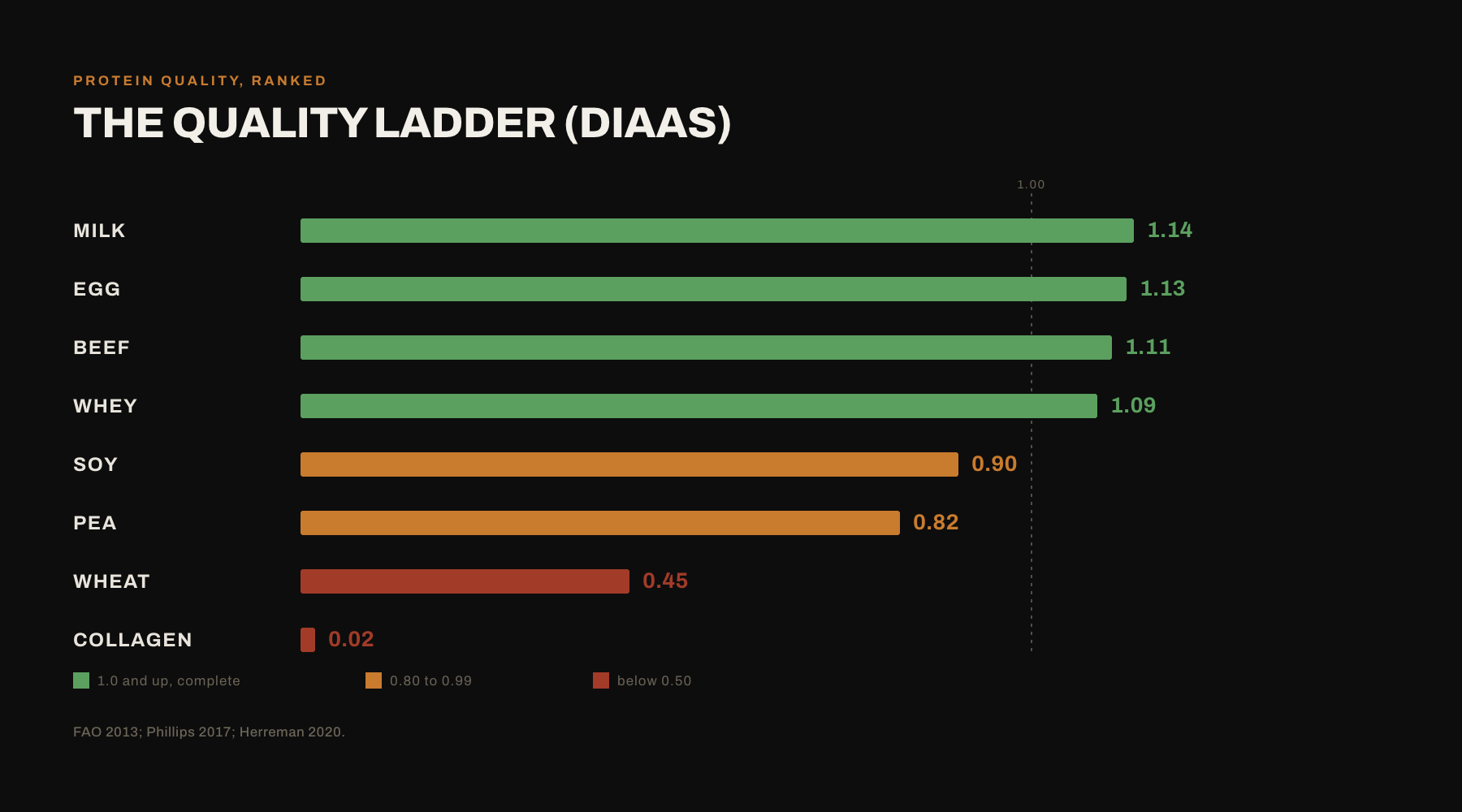
Scientists grade this with a measure called DIAAS, the digestible indispensable amino acid score, which the United Nations food agency recommends as the honest ladder of protein quality. It ignores the grams on the front and asks the real question: how much usable, complete protein does this food actually deliver? Rank eight everyday proteins that way and the order barely moves between studies, but you will never find it printed on a label. Guess the order, then reveal it.
The zero at the bottom of the ladder
Look at the floor. Collagen. It is one of the best-selling protein supplements in America, in the creamers and the gummies and the morning cup, and on the quality ladder it scores essentially zero. The reason is specific and damning: collagen is missing tryptophan, one of the nine essential amino acids, almost entirely. A protein that lacks an essential amino acid is, by definition, incomplete, and an incomplete protein cannot be counted as if it were whole.
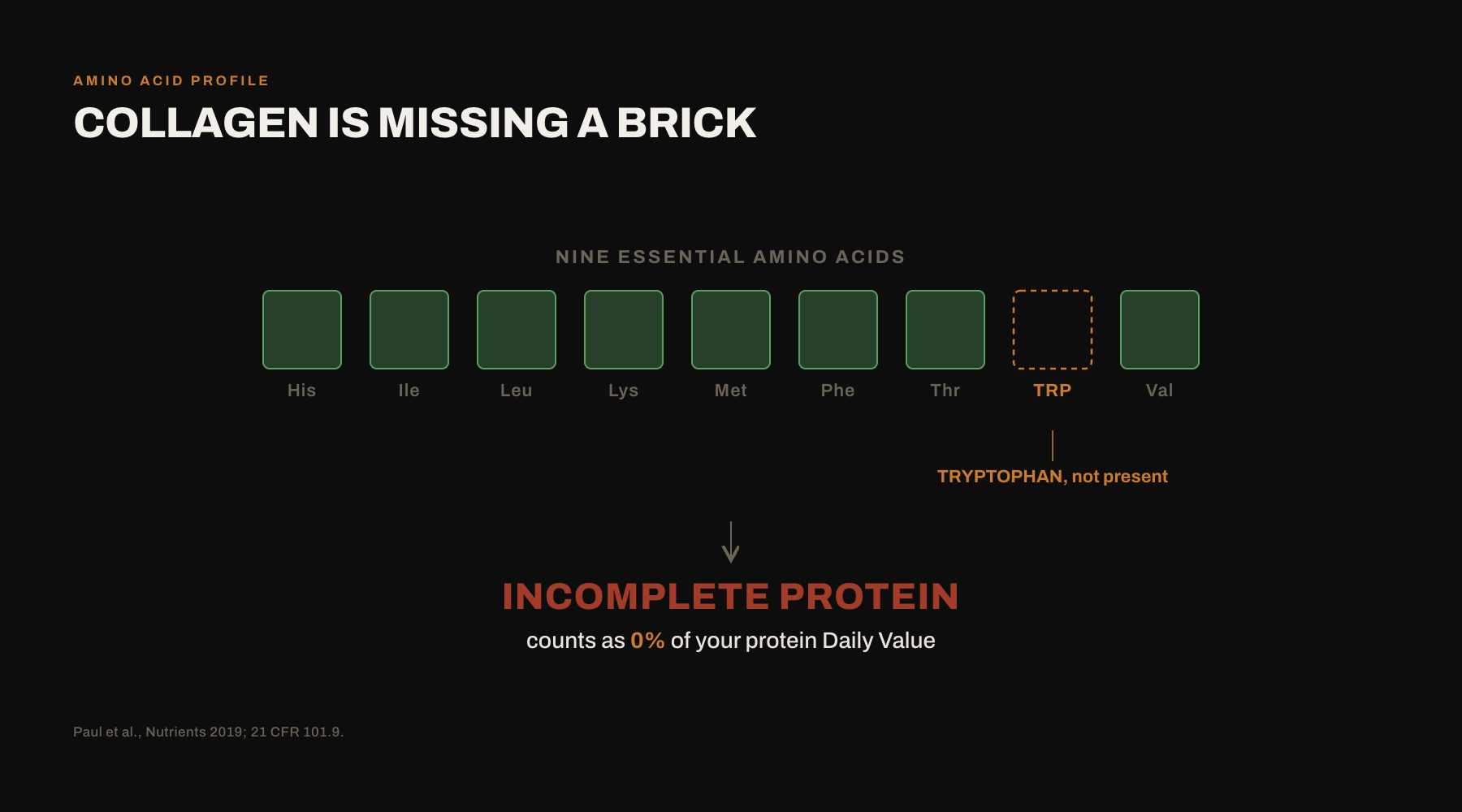
This is not a fringe reading. The FDA's own rules say a protein's contribution to your Daily Value has to be corrected for quality, and by that math a pure collagen product contributes effectively zero percent of your protein Daily Value, no matter how large the number on the front. In 2019 a collagen brand was taken to federal court for printing a twelve percent protein Daily Value it was not entitled to.
So how did a protein that scores zero become the protein in your morning cup? Through the creamer, and not because of anything it does for you. Collagen dissolves clear, tastes like nothing, and survives being stirred into a hot drink, three things real whey cannot do. It was the perfect powder to pour into a drink. Whether it fed you never entered the decision. Put a number and a source in below and watch what actually reaches your muscle.
Why The Shelf Protein Fights You
Whey and collagen did not win the shelf because they were the best proteins for a human body. They won because they were waste, and waste is cheap. Step through where whey comes from, one stage at a time.
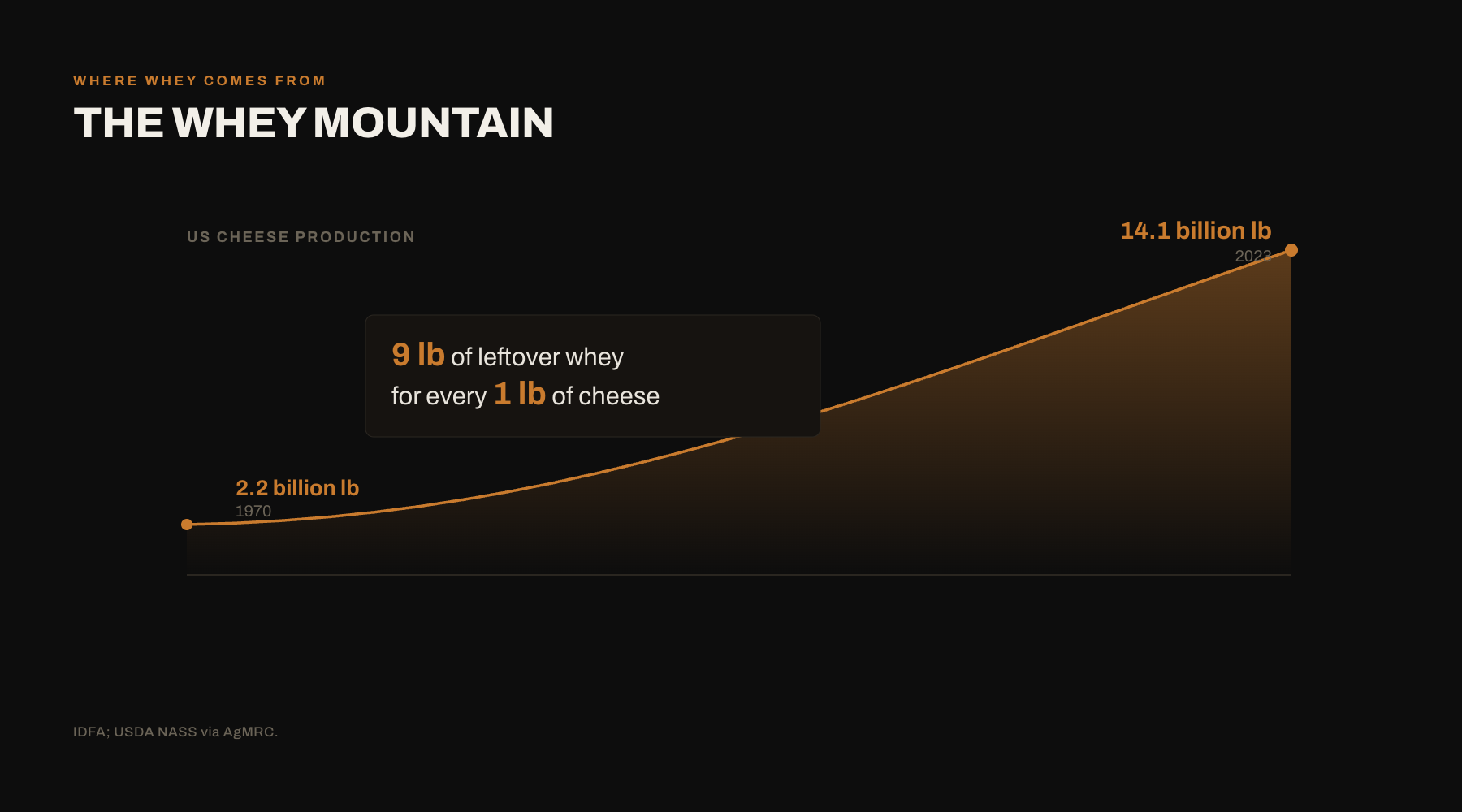
None of this makes whey poison. Whey isolate, filtered hard enough, is a genuinely good protein, near the top of the ladder you just ranked. But the tub on the shelf is usually the cheap grade, the concentrate, chosen because it costs less, and it drags the milk sugar and the clumping along with it. Collagen reaches the tub the same way, as hide and bone rendered by the gelatin trade. Demand for all of it is pushed hard from the top: the US dairy checkoff alone collected about 352 million dollars in mandatory producer assessments in 2022 to keep the product moving.
The shelf is not evil. It is indifferent. It optimizes for margin, and your body is not in that equation unless you put it there. Here is a test that puts it there, tonight, with no lab and no cost.
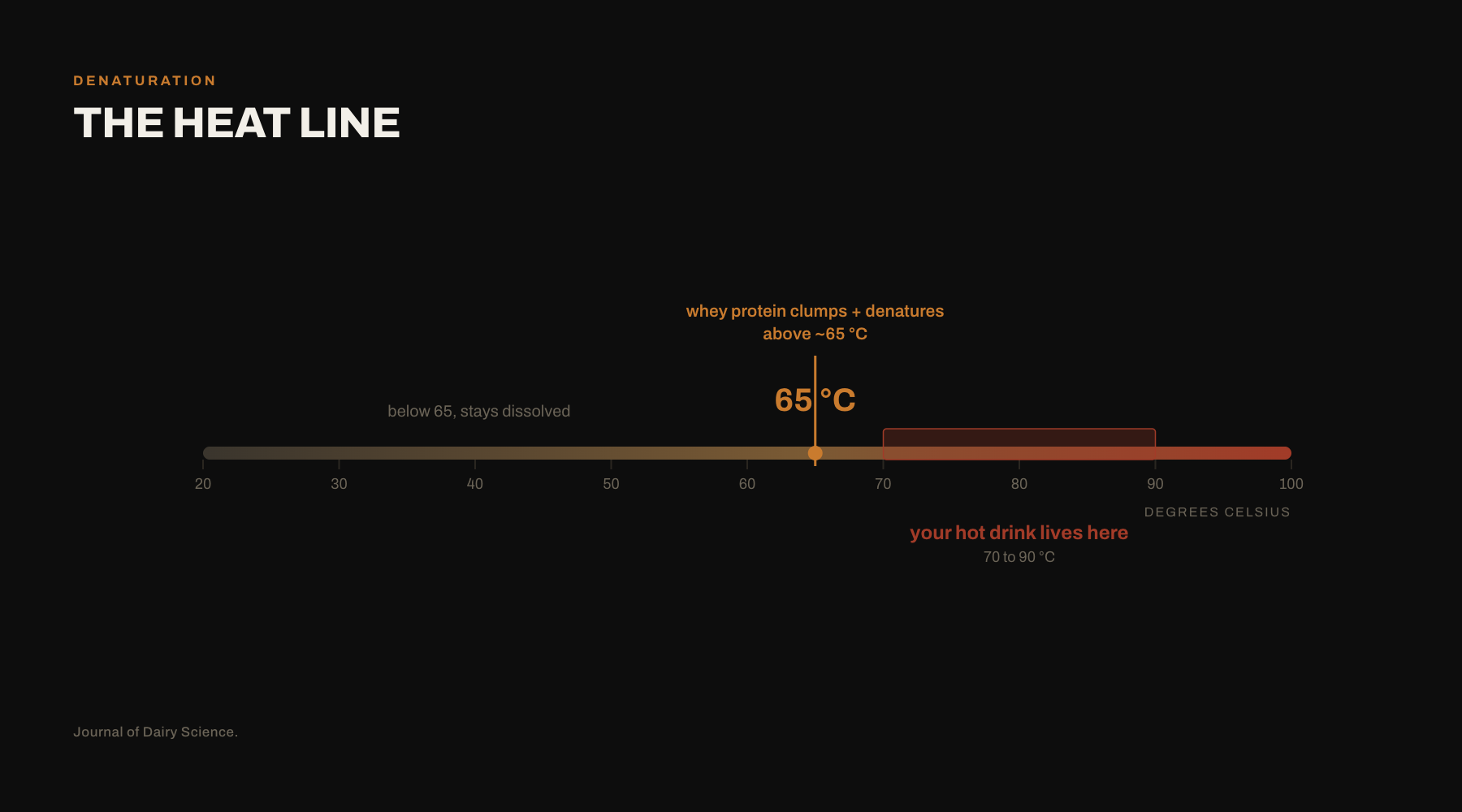
Put one scoop of your protein in a mug of just-boiled water and stir. If it clumps, films over, or turns gritty, you are watching whey protein denature above about 65 degrees. Photograph it. A protein actually built for a hot cup will not do that, and now you know how to tell.
Read The Tub In 60 Seconds
You do not need a lab. You need five questions and about a minute. Run them on any tub in any aisle and you will know more than the front of the package will ever tell you. Tap each one as you check it.
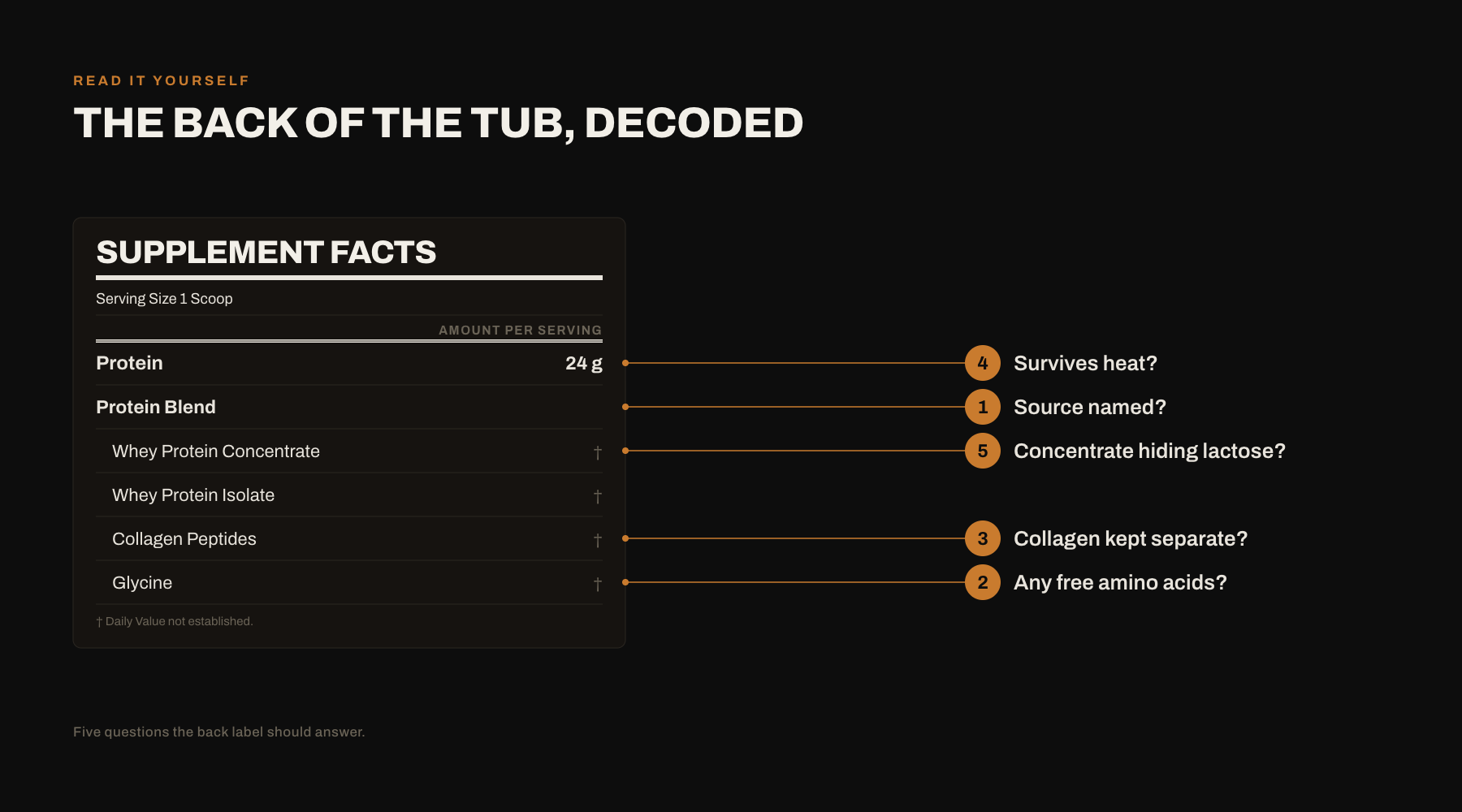
Five questions, and the words the industry uses to blur them. Hover any of these before you shop: a blendTwo or more protein sources mixed together. Legal, but it lets a label lean on a cheap source while naming an expensive one., an isolateA more filtered protein: higher purity, less fat and sugar than a concentrate., a concentrateA less filtered, cheaper protein that still carries fat and milk sugar, roughly 4 to 8 percent lactose for whey., something hydrolyzedPre-broken into fragments for faster digestion. Fine on its own, sometimes used to make spiking harder to spot., an amino complexA blend of free amino acids. A nitrogen-padding red flag when it sits inside a protein total., or a number that is nitrogen-correctedA protein figure adjusted for quality (PDCAAS). Almost nobody prints it, which is exactly the point..
Your first seven labels
One check a day. Pull a single protein product from your cupboard, run the five questions, and tap the day. It saves itself. By the end of a week you will read a supplement panel the way you read a price tag, fast, and without being fooled. Close this and come back tomorrow; it remembers where you were.
What a passing panel looks like
You are not hunting for perfect. You are hunting for honest. A tub worth buying answers all five questions the moment you turn it over, like this.
Be first when it drops.
This guide was the gift, and it stays free whether you ever hear from us again. But there is a protein that passes all five of these checks without you having to run them, built into the one habit you already keep every morning. It drops soon. Leave your number and we will text you the moment it does. Nothing else.
By tapping the button you agree to receive recurring automated marketing texts from Black Forest at this number. Consent is not a condition of purchase. Msg and data rates may apply. Reply STOP to cancel, HELP for help. We never share your number.
No name, no bottle, no pitch. Just the first honest tub we could build, in the place you were going to look anyway.
The Receipts
- Palacios v. Built Brands LLC, No. 3:24-cv-02234, U.S. District Court, N.D. California (2024). Bars labeled 17 g protein tested as low as 8 g. Reporting: Bloomberg Law; injuryclaims.com.
- Kjeldahl, J. (1883), Carlsberg Laboratory, Copenhagen. Protein measured as nitrogen × 6.25. Review: Protein Determination: Method Matters (2017), PMC5789268. U.S. rule: 21 CFR 101.9(c)(7).
- The 2008 melamine incident. Environmental Health Perspectives 117(12), 2009 (PMC2799451); WHO / Chinese Ministry of Health figures (as of 1 Dec 2008): ~294,000 affected, ~51,900 hospitalized, 6 deaths.
- Rodriguez v. Giant Sports Products, LLC, No. 2:14-cv-08378, C.D. California (2014). Alleged ~60% less protein; 3.926 g undisclosed glycine; nitrogen spiking. Lexology; Truth in Advertising.
- Innova Market Insights (2026), via FoodIngredientsFirst. Protein-claim launches up ~6%/yr since 2021, led by milk, pea, and soy isolates.
- FAO (2013), Dietary protein quality evaluation (DIAAS). Values: Phillips SM (2017); Herreman et al. (2020); Rutherfurd et al., J Nutr (2015).
- Paul, Leser & Oesser, Nutrients (2019), PMC6566836. Collagen lacks tryptophan; incomplete protein; PDCAAS ~0.
- 21 CFR 101.9(c)(7) (protein %DV must be quality-corrected) and McLaughlin v. JB7, LLC, S.D. Florida (2019), on a collagen "12% Daily Value" claim.
- FoodPrint, "Whey Too Much" (2024); The Counter (2019): whey as waste; ~9 lb whey per lb cheese. Regulatory driver: Clean Water Act (1972); EPA dairy effluent rules (1974-75).
- IDFA (cheese, 1970) and USDA NASS via AgMRC (2023): US cheese production 2.2 to 14.1 billion lb. Journal of Dairy Science on beta-lactoglobulin denaturation above ~65 C. USDA 2022 Dairy Report to Congress (via The Bullvine): ~$352.1M checkoff.
This guide is educational and is not medical advice. It does not diagnose, treat, cure, or prevent any disease. Every historical, legal, and numeric claim is drawn from the published sources listed above. Protein-quality scores are population averages and vary by product and preparation. Talk to your physician before changing your diet, especially if you have a health condition or take medication. Individual results vary.
Read The Back
To your strength,
Antonio Colmenares
Founder, Black Forest